February 2026 · U.S. economy · Monthly recap
A job decline needs context
Payrolls fell in the first estimate, while annual inflation stayed at 2.4%.
February’s jobs report looked weaker than January’s: the initial estimate showed a decline rather than a gain. But the detail mattered. BLS said strike activity contributed to the drop in health-care employment. A headline number can describe a change without fully explaining its cause.
What happened to prices?
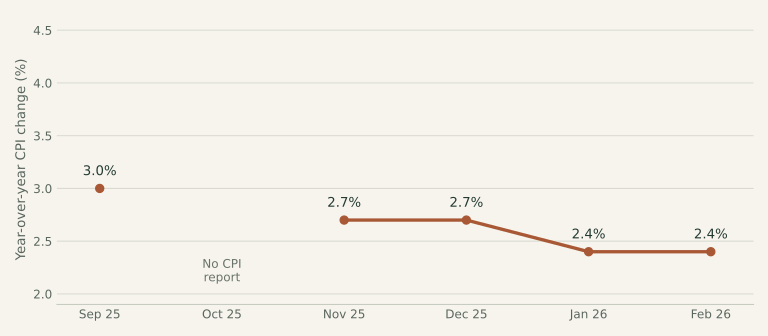
Consumer prices rose 0.3% over the month, after seasonal adjustment. The price basket was 2.4% higher than a year earlier, before seasonal adjustment. BLS price report.
View the chart data and sources
| Month | Annual CPI | Source |
|---|---|---|
| September 2025 | 3.0% | BLS release ↗ |
| October 2025 | Not available | BLS release ↗ |
| November 2025 | 2.7% | BLS release ↗ |
| December 2025 | 2.7% | BLS release ↗ |
| January 2026 | 2.4% | BLS release ↗ |
| February 2026 | 2.4% | BLS release ↗ |
What happened to jobs?
The linked release reported 92,000 fewer nonfarm payroll jobs. The unemployment rate was 4.4%. BLS attributed part of the health-care employment decline to strike activity. BLS employment report.
What this means in everyday life
A strike can affect whether workers are counted on payroll during the survey period without meaning their jobs have permanently disappeared. That does not make the decline irrelevant; it means the next report and the industry breakdown are especially useful. Meanwhile, February’s price increase meant the cost of living was still rising even with the annual rate unchanged.
One thing to keep in mind
Watch whether employment rebounds after temporary disruptions, and whether weakness spreads across industries. One month of falling payrolls is insufficient to establish a lasting downturn.
From the headlines to the classroom
AP Macro & Micro connections
Employment measurement & labor markets
AP Macro · Unit 2 · Economic Indicators and the Business Cycle
The recap notes that strike activity affected health-care payrolls. Practice distinguishing a measured payroll change from a conclusion that positions were permanently eliminated. The employment report combines employer and household surveys.
AP Micro · Unit 5 · Factor Markets
A labor market involves workers and employers negotiating the use and compensation of labor. Collective bargaining and temporary work stoppages add real-world detail beyond the simple competitive model. Do not treat every strike-related payroll decline as a leftward shift of long-run labor demand.
Try it yourself
If striking workers are absent from payroll during the survey period, does the payroll decline prove an equal number of permanent jobs was destroyed?
Reveal the explanation
No. Payroll counts can be affected by temporary work stoppages. The report’s definitions, industry detail, and subsequent data are needed to distinguish a temporary absence from a lasting loss.
Sources & reporting notes
BLS Consumer Price Index — February 2026 ↗BLS Employment Situation — February 2026 ↗This is a retrospective, researched on October 6, 2026. Figures describe the month named above, unless a different period is stated. CPI and employment values are as reported in the linked archived releases; later revisions may differ. This recap focuses on prices, jobs, interest-rate decisions, and selected policy changes. It is educational, not personalized financial advice.
Check your understanding
The three-question quiz
One question about the recap, one about AP Macro, and one about AP Micro. These are original learning questions.