March 2026 · U.S. economy · Monthly recap
An energy surge pushed inflation higher
Prices jumped as energy costs rose sharply, while the jobs report showed a rebound.
March changed the inflation story quickly. The monthly increase in consumer prices was much larger than February’s, and the annual rate climbed. The report identified a sharp energy increase as a major part of the picture. Employment, meanwhile, rose in the first estimate after February’s decline.
What happened to prices?
Consumer prices rose 0.9% over the month, after seasonal adjustment. The price basket was 3.3% higher than a year earlier, before seasonal adjustment. The energy index rose 10.9% in March, including a 21.2% rise in the gasoline index. BLS price report.
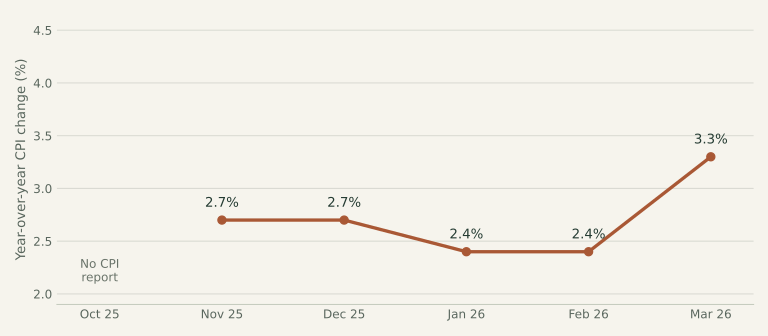
View the chart data and sources
| Month | Annual CPI | Source |
|---|---|---|
| October 2025 | Not available | BLS release ↗ |
| November 2025 | 2.7% | BLS release ↗ |
| December 2025 | 2.7% | BLS release ↗ |
| January 2026 | 2.4% | BLS release ↗ |
| February 2026 | 2.4% | BLS release ↗ |
| March 2026 | 3.3% | BLS release ↗ |
What happened to jobs?
The linked release reported 178,000 more nonfarm payroll jobs. The unemployment rate was 4.3%. BLS employment report.
What happened to interest rates?
The Federal Reserve held its target range at 3.50–3.75%. This is a benchmark for overnight bank lending, not the interest rate every consumer pays. Federal Reserve statement.
What this means in everyday life
Energy is visible in everyday life: at the pump, in heating bills, and in the cost of moving goods. A jump in energy prices can push up the overall inflation number even if other categories move more slowly. It is useful to distinguish a concentrated shock from a claim that every price is accelerating at the same rate.
One thing to keep in mind
Look at both overall inflation and the detail underneath it. The next question was whether the energy surge would fade or keep adding pressure to household budgets.
From the headlines to the classroom
AP Macro & Micro connections
Energy costs, supply shocks & production costs
AP Macro · Unit 3 · National Income and Price Determination
An increase in a widely used input cost can shift short-run aggregate supply left, raising the price level and reducing real output in the basic AD–AS model, all else equal. A cost decline can work in the opposite direction. The model helps explain a possible mechanism; CPI alone does not establish the cause of a real-world shock.
AP Micro · Unit 2 · Supply and Demand; 3 · Production, Cost, and the Perfect Competition Model
Fuel can be a variable input for a firm. A higher input price can raise marginal cost and reduce supply. However, the market price of fuel can also rise because demand increased, so a price change alone is not enough to identify a supply shift.
Try it yourself
Assume oil becomes more expensive because supply is disrupted. On an AD–AS graph with AD unchanged, what happens to SRAS, the price level, and real output?
Reveal the explanation
SRAS shifts left. The equilibrium price level rises and real output falls in the short run. Label the vertical axis Price level and the horizontal axis Real GDP, and show both equilibria. The supply disruption is an assumption in this question.
Sources & reporting notes
BLS Consumer Price Index — March 2026 ↗BLS Employment Situation — March 2026 ↗Federal Reserve decision — March 2026 ↗This is a retrospective, researched on October 6, 2026. Figures describe the month named above, unless a different period is stated. CPI and employment values are as reported in the linked archived releases; later revisions may differ. This recap focuses on prices, jobs, interest-rate decisions, and selected policy changes. It is educational, not personalized financial advice.
Check your understanding
The three-question quiz
One question about the recap, one about AP Macro, and one about AP Micro. These are original learning questions.