September 2025 · U.S. economy · Monthly recap
The Fed cut rates, but the squeeze remained
Borrowing policy eased even as annual inflation reached 3% and the unemployment rate stood at 4.4%.
September brought a change in interest-rate policy: the Federal Reserve lowered its target range. That was an important shift after months of holding steady. It did not erase the other pressures in the month’s data, including continued price increases and a softer employment backdrop.
What happened to prices?
Consumer prices rose 0.3% over the month, after seasonal adjustment. The price basket was 3.0% higher than a year earlier, before seasonal adjustment. BLS price report.
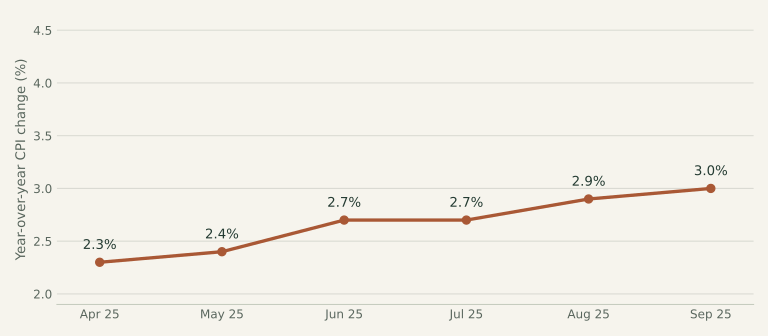
View the chart data and sources
| Month | Annual CPI | Source |
|---|---|---|
| April 2025 | 2.3% | BLS release ↗ |
| May 2025 | 2.4% | BLS release ↗ |
| June 2025 | 2.7% | BLS release ↗ |
| July 2025 | 2.7% | BLS release ↗ |
| August 2025 | 2.9% | BLS release ↗ |
| September 2025 | 3.0% | BLS release ↗ |
What happened to jobs?
The linked release reported 119,000 more nonfarm payroll jobs. The unemployment rate was 4.4%. BLS employment report.
What happened to interest rates?
The Federal Reserve cut its target range by 0.25 percentage point, to 4.00–4.25%. This is a benchmark for overnight bank lending, not the interest rate every consumer pays. Federal Reserve statement.
What this means in everyday life
A rate cut can reduce some borrowing costs and may also reduce the returns banks offer on savings. The effect depends on the product and how quickly lenders adjust. Existing fixed-rate loans do not automatically change when the Fed acts. The tension is straightforward: lower rates can support activity, while rising prices still strain budgets.
One thing to keep in mind
September’s inflation report arrived in October, and its jobs report was delayed until November. This retrospective uses those later releases to explain September; it does not suggest readers had all these figures during the month.
From the headlines to the classroom
AP Macro & Micro connections
Monetary policy & investment decisions
AP Macro · Unit 4 · Financial Sector; 3 · National Income and Price Determination
Trace monetary policy through interest rates to interest-sensitive consumption and investment. In the basic short-run model, easier credit can raise aggregate demand; tighter credit can reduce it. The policy target and a consumer loan rate are different numbers.
AP Micro · Unit 3 · Production, Cost, and the Perfect Competition Model
A business weighs the expected benefit of an investment against its cost. Financing costs can influence whether equipment expansion is worthwhile. A rate change does not tell us that the firm’s productivity or product demand changed.
Try it yourself
Assume the central bank lowers rates and businesses respond by increasing investment. With SRAS unchanged, how does the basic AD–AS equilibrium change?
Reveal the explanation
Aggregate demand shifts right. In the short run, real output and the price level rise along an upward-sloping SRAS curve. State the assumptions: borrowing rates respond, investment increases, and no offsetting shocks occur. A real rate cut does not guarantee all of these outcomes.
Sources & reporting notes
BLS Consumer Price Index — September 2025 ↗BLS Employment Situation — September 2025 ↗Federal Reserve decision — September 2025 ↗This is a retrospective, researched on October 6, 2026. Figures describe the month named above, unless a different period is stated. CPI and employment values are as reported in the linked archived releases; later revisions may differ. This recap focuses on prices, jobs, interest-rate decisions, and selected policy changes. It is educational, not personalized financial advice.
Check your understanding
The three-question quiz
One question about the recap, one about AP Macro, and one about AP Micro. These are original learning questions.